


Proud recipient of the following awards:


Popular:
Gun Control
Messi
Marijuana
Religion
Elon Musk
Circumcision
United States
Popular:
More than six hours before American troops storm the beaches, courageous U.S. pathfinders parachute into Nazi-occupied Normandy. In teams of around just 18 men, they brave darkness and the threat of German fire to set up lights and radar beacons for the 101st Airborne Paratroopers forces following them.
Allied airborne troops begin landing behind the coastal defenses. In the Utah sector, Germany’s 709th Infantry Division guards the coast, while the 91st Airlanding Division helps defend the inland area. German commanders must work out where the attacks are coming from and protect key roads and crossings, while keeping troops ready for a possible landing from the sea.
Over 13,000 American paratroopers from the 82nd and 101st Airborne Divisions descend behind Utah Beach, taking on the task of opening the way for the invasion force. The 101st must secure the inland exits of four causeways across ground flooded by German defenders, allowing the 4th Infantry Division to advance from the beach. Farther inland, the 82nd lands with orders to capture Sainte-Mère-Église and secure crossings over the Merderet River, helping protect the invasion’s western flank.
Behind Utah Beach, the marshes and flooded fields leave only four main raised roads for American troops to cross. By holding these roads, German soldiers could stop Americans moving inland from the beach and joining the paratroopers. But scattered parachute landings make it difficult for German commanders to know where to send their troops.
Clouds and German antiaircraft fire force aircraft off course, leaving many American paratroopers far from their planned landing zones. Despite the confusion, soldiers from different units join together and attack nearby German positions. Their courage and quick thinking also confuse German commanders, who struggle to work out where the main attack is coming from.
Near Saint-Floxel, staff and guards at a battalion headquarters of the 709th Infantry Division fight American paratroopers landing nearby. Similar clashes break out across the countryside. German commanders struggle to work out how many Americans have landed and where the main attack is coming from, making it harder to organize a response.
About 12 miles off the French coast, American soldiers climb from transport ships into smaller landing craft for the dangerous approach to France. The widely used Higgins boat can carry up to 36 fully equipped troops. Years of planning now depend on getting men, weapons, and vehicles across the remaining stretch of water and onto the beaches.
General Erich Marcks, commander of Germany’s 84th Army Corps, sends a reserve force built around the 915th Grenadier Regiment toward reported parachute landings south of Carentan. The force is on the road by 3 a.m., but the reports later prove false. German commanders are still trying to identify the main threat, and important troops are being sent away from the accurate landing areas.
A group from the 82nd Airborne Division’s 505th Parachute Infantry Regiment, led by Major Edward Krause, captures this key road junction behind Utah Beach. Taking the town helps block a major route German troops could use to threaten the landings. The Americans must now hold their hard-won position against counterattacks while other paratroopers fight for crossings over the nearby Merderet River.
American paratroopers capture Sainte-Mère-Église, an important road junction behind Utah Beach. Its position on the main road between Cherbourg and Carentan makes the loss a serious threat to German movement. German troops now face American forces inland as well as the expected attack from the sea, and must try to regain the town.
With the Utah and Omaha landings about 90 minutes away, American paratroopers are already fighting behind German lines. Their scattered attacks make it harder for German commanders to identify the main threat and decide where to send troops. This confusion buys valuable time as American forces prepare for the risky beach landings.
Germany has prepared for an invasion, but many senior commanders expect it at Pas-de-Calais, where the English Channel is narrowest. Allied efforts to mislead them have strengthened this belief. Some think the Normandy attacks are meant to distract them from a larger landing elsewhere, making it harder to decide where to send more troops.
Allied ships open fire on gun positions and fortifications to clear the way for American troops. Between 5:55 and 6:14 a.m., 329 American B-24 bombers drop over 13,000 bombs over the Omaha invasion area. But weather and efforts to avoid hitting approaching troops cause the bombs to fall too far inland, leaving many beach defenses still standing. The Americans heading ashore will still face deadly fire.
Allied warships bombard German gun positions before the beach landings. At Omaha, many defenses survive. American bombers drop more than 13,000 bombs, but these fall too far inland to do much damage to the beach defenses. German troops in surviving bunkers and gun positions remain ready to fire on the approaching Americans.
Soldiers of the 1st and 29th Infantry Divisions land under heavy German machine-gun and mortar fire. German defenses overlook the beach from steep slopes as rough seas have already sunk 27 amphibious tanks, leaving sections of the assault with far less support than planned. Despite heavy losses, the Americans fight to cross the open beach and break through the defenses above them.
German troops fire machine guns, mortars and large guns from protected positions 100–170 feet above the beach. From there, they can fire at Americans moving through the water and across the open sand. Many German defenses survive the bombing and shelling, allowing troops to cause big losses for the American soldiers and block the main roads inland.
The 4th Infantry Division lands about 2,000 yards south of its intended location at Utah Beach. Brigadier General Theodore Roosevelt Jr. lands with the first wave and decides to continue from there. The unexpected landing point has weaker German defenses than the planned site. Roosevelt’s quick decision helps American troops move off the beach and head inland.
German troops of the 709th Infantry Division defend Utah Beach with guns, mines and beach obstacles. But American troops land about 2,000 yards south of their planned location, where German defenses are weaker. As Americans move ashore, German defenders face pressure from the beach and from American paratroopers already fighting inland.
An assault force of about 225 Rangers, led by Lieutenant Colonel James Rudder, attacks cliffs roughly 100 feet high under German fire. Their mission is to destroy heavy guns threatening the American landings. After the challenging climb, they discover that the Germans have moved the guns inland. The determined Rangers push on to find and disable them.
German troops defend a fortified position between Utah and Omaha beaches as an American force of about 225 Rangers attacks. The defenders fire down the 100-foot cliffs, trying to stop the climb. As Rangers reach the top, German troops face close fighting among the damaged bunkers and trenches. The heavy guns the Americans seek have already been moved inland, so capturing the clifftop will not end the battle.
Small groups of soldiers and Rangers fight their way up the steep slopes between heavily defended beach exits. Between 8 and 9 a.m., more than 600 men move off the Dog White section of Omaha Beach. Their courage opens a way inland, but these early groups have few heavy weapons, no tanks alongside them, and limited radio contact. German positions still block many routes off the beach.
The defense risks being outflanked as Americans move beyond the beach. German positions can still delay them, but holding individual strongpoints no longer guarantees an unbroken defensive line.
American troops fight past German defenses and begin moving inland. By 11 a.m., soldiers of the 116th Infantry Regiment and the 5th Ranger Battalion clear Vierville-sur-Mer, a village above the beach. Despite this hard-won progress, hedgerows and German machine guns slow the advance. Small groups fight separate battles, often with few heavy weapons and limited radio contact.
Behind Omaha Beach, German troops fire from hedgerows and other sheltered positions. American groups that have reached the high ground face machine-gun fire and shelling as they move inland. Although gaps have opened in the coastal defenses, surviving German positions continue to slow their progress.
General Omar Bradley receives confirmation that troops are advancing onto the high ground behind Easy Red, Easy Green and Fox Red, three eastern sections of Omaha Beach. American soldiers have also overcome German strongpoint WN72 on the western side. Their courage has helped the attack survive its worst hours, but German resistance continues and the beach is still very dangerous.
The 352nd Infantry Division reports that American troops have been driven back into the sea, with fighting continuing only near Colleville-sur-Mer. The report is passed to Army Group B, giving senior commanders the impression that the situation is under control. In reality, Americans remain ashore and are advancing inland, while German defenders struggle to contain them. raf.mod.uk
As American troops strengthen their positions at Utah and Omaha, British forces face a counterattack by the German 21st Panzer Division north of Caen. British tanks and artillery beat back the main attack. Some German units reach the coast between Juno and Sword beaches, but later withdraw. This British success helps protect the invasion’s eastern flank while the Americans continue fighting farther west.
The 21st Panzer Division is the only armored formation immediately available for a counterattack. and advances against British forces north of Caen. Some of its troops have already been fighting British paratroopers. German commanders now rely on the division to push toward the coast before the Allies can strengthen their positions. British tanks and artillery repel the main attack, although some German units reach the coast before withdrawing.
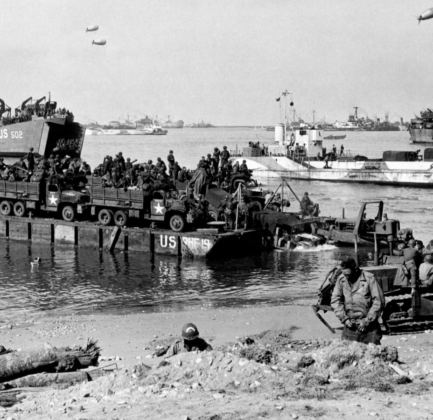
By about 9:30 p.m., roughly 20,000 American troops and 1,700 vehicles have arrived at Utah Beach. At Omaha, soldiers continue securing the ground won through hours of fierce fighting. The Americans have held both beaches, but German resistance remains, and the landing areas are not yet fully connected with the other Allied beaches
Despite hours of resistance, German defenders have been unable to stop Allied forces from establishing positions at all five beaches. Surviving German units continue fighting, but confused reports and delayed reinforcements make a coordinated response difficult. Their task is now to hold the remaining positions and prevent the Allies from pushing farther inland.
73,000 American troops have landed by sea and air during D-Day. Their courage and sacrifice have helped establish the Allied foothold in Normandy, but German resistance remains strong and the landing areas are not yet fully connected. Nearly eleven more months of fighting lie ahead before victory in Europe on May 8, 1945
German forces have failed to stop the Allies from gaining footholds at all five beaches. Despite losing coastal positions, German troops still hold much of the countryside and continue to resist. They now face a growing Allied force ashore, with more troops and supplies on the way. The battle for Normandy is only beginning.

